|
Medical
Student Corner
Severe Anxiety
A.P. is a
35-year-old woman who presents to your office with severe anxiety of six
months' duration.
She states
her anxiety is worst in the morning, particularly on her way to work.
Symptoms subside during the day, but recur in the evening on the way home.
The symptoms
are described as "being trapped," "feeling out of control,"
and "feels like I'm suffocating." She has presented twice to
New York Downtown Medical Center - both times brought by the concerned
passengers in her carpool, and both times diagnosed with hyperventilation
and anxiety.
Of note,
she has no symptoms on weekends.
Previous
medical and surgical history is unremarkable. She takes no medications,
denies allergies, and does not smoke or drink. She works as a clothing
sales representative on West Broadway.
On physical
exam, the patient is in no apparent distress. Her mood and affect appear
appropriate, and her demeanor is pleasant.
Temperature
is 97.7F, pulse is 80, blood pressure is 120/70, and respirations are
12.
Head and
neck, lung, heart, and abdominal exams are normal.
Screening
laboratory studies show normal complete blood count, electrolyte panel,
and thyroid studies.
You are stymied
until you note that the patient commutes to work from East Hanover, NJ.
Quickly obtaining
a map of the Tri-State area from your receptionist, your suspicions are
confirmed by a careful examination of the patient's driving route:
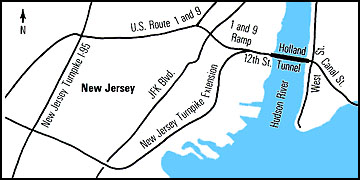
What's
going on?
Answer:
Carpool Tunnel Syndome
This woman,
who presents with severe anxiety while traveling to and from work, has
Carpool Tunnel Syndrome.
The presence
of the Holland Tunnel on a map of the driving route of a patient who carpools
to work is pathognomonic for the disorder.
Upon further
questioning, the patient revealed that her anxiety was indeed at its height
during the 1.5 mile stretch within the Holland Tunnel to and from work
each day.
Experiencing
sensations of claustrophobia and air hunger is not uncommon among people
driving through lengthy subterranean tunnels - sensations which may be
compounded when traveling with two or more strangers from a RideShare
program.
The diagnosis
can be further confirmed by meeting the patient's carpool passengers in
person, making note of any odd and/or eccentric behavioral anomalies which
may be misconstrued as threatening or antisocial.
Treatment
is straightforward and involves building a new above-ground roadway traversing
the Hudson River wide enough to accomodate a large number passengers traveling
singly, thereby eliminating the need for carpools. The addition of ample
parking space in the city itself for the enormous influx of automobiles
which would then ensue is also desirable.
Alternatively,
the patient can simply find a job in Hoboken; either method is safe, cost-effective
and covered by most insurance plans.
|


