|
Ball-Peen
Hammer Shows Activity Against Tumor Cells
Clinical application may be years away, caution scientists
CLEVELAND,
OH--In a development that may revolutionize the treatment of cancer, a
researcher at Morrison University has announced the discovery of a technique
that effectively destroys 99.9% of cancer cells in vitro.
In his groundbreaking
laboratory work, Dr. Barry Pinsky has been able to destroy malignant cells
by whacking their glass or plastic containers repeatedly with a hammer,
thus pulverizing the contents to a fine pulp and spilling the nutrient
broth that sustains them all over the floor.
 |
|
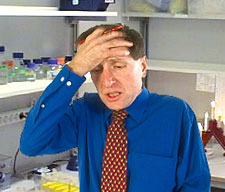
Distraught
researcher
Dr. Barry Pinsky
|
Pinsky's
group says an element of serendipity was at frist involved. According
to Dr. Eli Bergerman, whose lab is across the hall from Pinsky's, "Barry
came in at nine, and then around ten he got a call telling him his research
funding had dried up."
"Well,
he was already a little on the touchy side, ever since his wife took off
with one of his grad students. All of a sudden he just grabbed a hammer
that was lying on a bench."
The distraught
researcher then "went postal," according to sources at the scene.
In a remarkable
series of subsequent experiments, which took place shortly before Pinsky's
loss of lab space and academic appointment, it was demonstrated that all
tumor cells in the laboriously maintained cell cultures had been destroyed,
through a process scientists have christened "smashing."
"Smashing,"
in which living cells are suddenly and repetitively subjected to extreme
external forces, has been shown to result in rapid leakage or spurting
of cell contents, followed rapidly by cell death.
While the results have created tremendous commotion in the cancer research
community, experts cautioned that it may be some time before cellular
"smashing" becomes a regular part of the anti-cancer armamentarium.
Dr. Clovis
O'Rourke, an oncologist at Central West Memorial Hospital in Topeka, KS,
argued that some tumors may be difficult to "smash" with ball-peen
hammers, "particularly if they are located in or near vital organs,
like the heart, lungs, or brain."
|


