|
History
Of Medicine
Oral Anticoagulants
The WHOLE Story Series: Part I
Sweet
clover was grown in the North American Plains and Canada in great abundance
around the turn of the century. It flourished in poor quality soil and
was a reasonably good corn substitute in animal feeds.
In 1924,
Schofield noted a hemorrhagic disorder in cattle that seemed to result
from the ingestion of spoiled sweet clover. Unfortunately, the sight of
blood revulsed him, and eventually led to his permanent institutialization.
 |
|
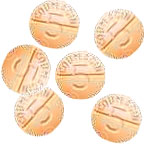
Coumadin
(warfarin)
|
Roderick,
however, traced the cause of the bleeding disorder to a reduction in plasma
prothrombin, and in 1939 Campbell and Link identified the hemorrhagic
agent as bis-hydroxycoumarin (dicumarol).*
Because the
first use of the compound (which came to be known as WARFARIN, based on
the acronym for the patent holder, Wisconsin Alumni Research Foundation
And Raisin Incubator Nose), was as a rodenticide, therapeutic applications
were not initially recognized.
That was
until 1951, when a distraught Army recruit took eight bottles of rat poison
and found himself suffering only from some foul smelling flatus. Subsequently,
for unrelated reasons, oral anticoagulants (mostly Warfarin) became the
primary therapy for thromboembolic disease.
Medical technology
and an increased understanding of thrombotic disorders have created many
new indications for warfarin over the years. These include prosthetic
heart valves, atrial fibrillation, stroke, and cerebellar short wave radio
implantation. In addition, warfarin therapy requires that coagulation
parameters be assessed every few weeks or so, or in some cases every five
minutes, thereby generating millions of dollars in laboratory revenue.
The dosing of warfarin has been subject to great debate over the years.
For example, if a patient requires 5 mg of warfarin each day, this could
be dosed as 5 mg once per day, 2.5 mg twice per day, 1 mg five times per
day, or 10 mg every other day, not including the third Thursday in March.
Warfarin
should not be given to certain high-risk individuals, such as the elderly,
who may be at risk of falls. It should probably also be avoided in boxers
and professional wrestlers.
It is absolutely
contraindicated in elderly boxers and professional wrestlers with a history
of falls.
Warfarin levels are affected by every substance known to man.** Still,
there is hope that a less volatile form of oral anticoagulation will someday
become available.
Until then,
the medical profession must continue to rely on this interesting and useful
substance derived from spoiled sweet clover, which the natives once called
"maize."
And
that's the WHOLE Story!™
* That Campbell,
Link and/or Roderick were romantically involved is not at all implied
or suggested anywhere in the literature, although Link's original manuscripts
make many references to Roderick's seersucker suit.
** Even Cheetos.
|


