|
Medical
Student Corner
Abdominal Pain
The patient
is a 32-year old Greek male who presents to the Emergency Department with
the chief complaint of acute abdominal pain.
The pain,
described as diffuse, began suddenly twelve hours prior, and has been
increasing steadily since then. It is accompanied by severe nausea, with
frequent vomiting and inability to tolerate oral intake.
Of note,
in addition to his abdominal complaints, the patient also states he has
a sore throat which feels "a little hoarse," and has a sharp
pain in his right ankle which is worsening.
No previous
such episodes are reported.
The patient
denies past medical or surgical conditions, is on no medications, and
has no known drug allergies.
Social history
reveals that the patient is married, has two children, and does not smoke
or drink alcohol.
On physical
exam, the patient appears acutely ill, and is noted to have frequent episodes
of retching.
There is
an unusual "scratchiness" to the patient's voice.
Temperature
is 101.1F, pulse is 120, blood pressure is 120/85, and respirations are
35.
Head and
neck, lung, and heart exams are normal.
Abdominal
exam is significant for diffuse tenderness and decreased bowel sounds,
with mild guarding, and no rebound tenderness.
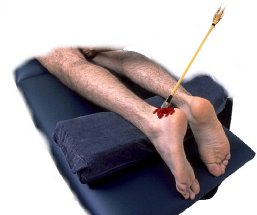
Close examination
of the patient right ankle reveals the following:
What's
going on?
Answer:
Homer's Ileus
This patient's
signs and symptoms, which include vomiting, abdominal pain, and decreased
bowel sounds, along with an arrow piercing the Achilles tendon, are highly
suggestive of Homer's Ileus.
A raspy sore
throat solidifies the diagnosis, and results in a distinctive vocal quality
known as "the Trojan hoarse."
Homer's Ileus,
a rare disorder occuring in less than 0.02% of Americans, is nevertheless
fairly frequent in people of Mediterranean descent, and should always
be suspected when abdominal pain, decreased bowel sounds, and an arrow
piercing the Achilles tendon occurs in this group.
Treatment
involves fluids, surgical consultation, and the construction of a large
wooden fleet upon whose sturdy decks the mighty Acheaen army shall speed
toward the Hellespont.
Successful
resolution of the instestinal conflict is usually achieved within one
to two weeks; recovering patients are encouraged to ride their chariots
triumphantly around the Coliseum, dragging their vanquished enemies behind
them.
|


