|
Medical Student Corner
Hand And Foot Pain
A 31-year-old white male is seen in Urgent Care for
the chief complaint of hand and foot pain beginning abruptly three days
ago, and progressively worsening since then.
Prior to the onset of pain, he noted several days
of intermittent cough, low grade fever, and chills.
Pain is described as diffuse, very severe, and sharp,
and confined to the skin of the hands and feet.
The patient denies any other symptoms.
Of note, he remembers eating recently at Wendy's,
a fast-food restaurant, where he ordered a Bacon Double Cheeseburger,
but received a plain Double Cheeseburger instead (without bacon).
No previous episodes are reported.
Social history reveals that the patient is single,
heterosexual, and has smoked two packs of cigarettes per day for fifteen
years.
He now presents for further evaluation and management.
On exam, he appears fatigued and satiated.
Temperature is 100.1F, pulse is 75, blood pressure
is 110/70, and respirations are 14.
Aside from bilateral hand and foot tenderness, the
remainder of the patient's examination, including throat, chest, heart,
abdomen, and neurologic exam, are within normal limits.
Laboratory studies, including urinalysis, are normal.
The results of a skin biopsy from his right foot
are pending.
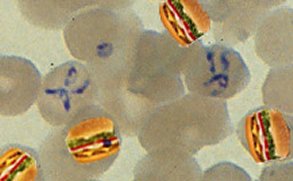
Examination of the patient's peripheral
blood smear reveals the following:
What's going on?
Answer: Buerger's Disease
Buerger's Disease, named after American physician
Dr. Leo Buerger, who first described the disease in 1908, is a rare disorder
of the blood vessels of the hands and feet.
An unexplained association between cigarrette smoking
and Buerger's Disease has long been known; smoking cessation often results
in vast improvement and/or resolution of the condition.
Affected individuals initially develop progressive
tenderness in their distal extremities, followed by the appearance of
ulcers in the involved areas.
These are the result of widespread thromboangiitis
involving the vessels of the hand and feet.
Examination of the peripheral blood smear often reveals
buergers and occasionally french fries; in one case reported in Manchester,
England, a Super-Size™ Coke™ was reported on skin biopsy, although
this has not been confirmed by authorities.
Of note, the appearance of lettuce, tomatoes, and
cheese in the buergers, as demonstrated in the slide above, is pathognomonic
for Buerger's disease, and distinguishes it from other conditions in which
buergers and fries may be visible on the peripheral blood smear.
Treatment consists of smoking cessation or extremity
amputation, depending on the wherewithal of each particular patient's
preference and motivation.
More information on buergers and fries can be found
at the Mayo Clinic website.
|


