|
Medical Student Corner
Headache
A 40 year old white male is seen in the Emergency
Room for the chief complaint of a headaches, which began abruptly three
days ago, and has progressively worsened since then.
Prior to the onset of
his headaches, he noted several days of intermittent fevers, fatigue,
chills, sweats, and "confusion."
The headaches are described
as diffuse, very severe, and sharp, and worsen when he "looks at
light."
The patient denies hearing
loss, visual changes, tinnitus, or motor or sensory defects.
Of note, he states that
he may have been bitten by an insect, "possibly a mosquito,"
on his right forearm several days prior to onset of headaches.
No previous episodes are
reported.
He now presents for further
evaluation and management.
On exam, he appears fatigued
and somewhat disoriented.
Temperature is 101.1F,
pulse is 95, blood pressure is 110/70 and respirations are 16.
Aside from moderate neck
stiffness, the remainder of the patient's examination, including throat,
chest, heart, abdomen, and extremity exam are within normal limits.
Laboratory studies, including
urinalysis, are normal.
The results of a lumbar
puncture are pending.
Upon closer
examination, you note the presence of a subtle physical finding that you
and the team had previously overlooked:
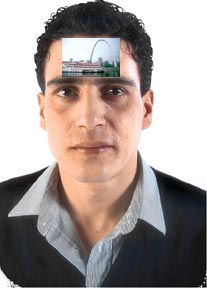
Further
evaluation with a magnifying glass reveals the following lesion on the
patient's forehead:

What's going on?
Answer:
St. Louis Encephalitis
This man most likely has St. Louis Encephalitis,
an arthopod-borne illness whose vector is the Culex mosquito, prevalent
in the Western and Central U.S. during the months of June through October.
The presence of the Gateway Arch, a national landmark
located in St. Louis, MO, on the forehead of a patient with headache,
fever, and confusion is pathognomonic for St. Louis Encephalitis.
It is often difficult to detect the presence of the
Gateway Arch on a patient's forehead without the use of special diagnostic
equipment; therefore, a strong clinical suspiscion is invaluable in making
the diagnosis.
St. Louis Encephalitis differs from other conditions
in which an arch appears on a patient's forehead by the presence of a
large riverboat near the arch, as seen in the close-up above.
Treatment involves supportive care, and frequent
wiping of the forehead with hydrogen peroxide.
|


