|
History Of Medicine
The Discovery Of Penicillin
Mr. Fleming's magical mold
In this day of broad spectrum antibiotics, it's easy
to forget that there was once a time when physicians lacked any
effective therapy for bacterial infections.
Although the 1920's saw the discovery that central
nervous system syphillis could be treated by infecting people with malaria,
subsequent attempts to cure gonorrhea by giving people ringworm, genital
herpes by giving people colds, and genital warts by giving people cellulitis
were unsuccessful.
Clearly, a "magic bullet" was needed!
 |
|
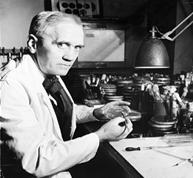
Sir Alexander Fleming
|
Traditionally, it has been thought that Alexander
Fleming discovered penicillin when he noticed a mold growing on his Petri
dishes: wherever the mold grew, bacteria died.
In fact, the true story is much more complicated...
and INTERESTING!
The mold actually grew on Fleming himself, initially
covering his feet below the ankles with a thin blue fuzz, and ultimately
extending all the way up to the middle of his abdomen. Fleming remained
moldy for about 6 weeks; during that whole time he observed that he didn't
get sick even one time.
Fleming realized that the mold that had been growing
on him was Penicillium, or bread mold. He set about culturing more
mold on any bread he could lay his hands on, including the sandwiches
and hamburger buns that belonged to his lab staff.
By the middle of 1939, Fleming had enough bread mold
to fill a telephone booth... but then WAR broke out.
Fleming's mold-filled telephone booth was transported
to the front. It was struck by a shell, and the mold was destroyed.
America realized: something had to be done, SOON!
Every day, hundreds of soldiers were contracting gonorrhea in the line
of duty!
Fleming had an idea: he immediately deployed a crack
team of scientists to riffle through the refrigerators of students across
Britain. A search revealed huge quantities of moldy food, yielding a precious
supply of "penicillin", as it is now called.
However, administering penicillin was difficult.
Often, an infected wound would be rubbed directly with a piece of moldy
bread, leading to friction burns. It was even more difficult to give the
drug intravenously, as crumbs would clog the IV tubing.
Two brilliant scientists, Florey and Chain, developed
the idea of scraping the mold off the bread with a specially designed
fork. They shook the mold off the forks into the special glass vials and
plastic IV bags that penicillin comes in today.
Join us for our next History Of
Medicine vignette, coming soon!
|


