|
Medical Student Corner
Back Pain
A 48 year old male is seen in general medical clinic
for the chief complaint of back pain, which began 2 weeks ago during a
trip to the Adirondack Mountains in upstate New York.
The patient denies trauma or having lifted unusually
heavy objects, and states the pain is concentrated in his mid-to-upper
back bilaterally.
Symptoms are described as a "heaviness and a
soreness," and are worst in the evening, but appear least noticeable
when he lies flat on his stomach.
Of note, the patient is only able to lie prone or
on his side; he is unable to lie on his back due to excessive discomfort.
The patient states he has had more fatigue than usual,
and has been noted by family and close friends to seem "odd, like
there's something we can't put a finger on."
He denies fever, rash, vomiting, constipation, diarrhea,
or abdominal pain.
Motrin and Tylenol on an as-needed basis has resulted
in fair pain control, "but it always comes back."
He now presents for further evaluation and management.
On exam, he appears well-developed and well-nourished,
in no apparent distress.
Vital signs are unremarkable.
Head & neck, throat, chest, heart, abdomen, and
neuro exam are all within normal limits.
Laboratory studies, including urinalysis, are normal.
A close inspection of his upper back
with a magnifying glass reveals the following:
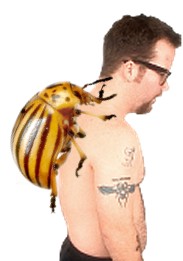
What's going on?
Answer: Dog Tick
This man has a dog tick on his upper back. This tick,
so named because it is approximately the size of a small dog, is a frequent
cause of upper back pain in residents of, and travelers to, certain areas
of the United States.
Typically, patients will present with heaviness and
soreness in the mid-to-upper back, due to the fact that the typical dog
tick weighs between ten to twenty pounds (4.5-9 kg).
It is often difficult to detect the presence of such
ticks with the naked eye, and a detailed examination with a magnifying
glass is sometimes necessary. A high degree of clinical suspicion is indispensable.
Treatment involves removal of the tick with tweezers,
along with a fourteen day course of oral doxycycline (as these ticks are
carriers of pathogenic Rickettsiae sp.)
Prevention involves wearing ample amounts of thick
clothing and OFF! insect repellent, and avoiding areas where these pesky
insects live and breed.
|


