|
Medical Student Corner
Case Studies: Flank Pain
A 35 year old woman presented to Medical Walk-In
Clinic with the chief complaint of the sudden onset of severe intermitent
right flank pain for 6 hours.
She noted moderate nausea with one episode of vomiting,
but denied fever, abdominal pain, or diarrhea. She did note a slightly
dark discoloration of her urine without dysuria.
Past evaluations for similar symptoms, including
plain films, intravenous pyelograms, and ultrasounds had been unrevealing.
In all previous episodes, her symptoms had resolved within three days
of onset with supportive therapy.
The patient describes the pain as being "right
here [motioning towards her right flank], under my thumb," and states
that she "just wants some satisfaction here - it's time somebody
figured this thing out."
She now presents for further evaluation and management.
On exam, the patient appeared well-developed and
well-nourished, but in some distress due to pain.
Vital signs were unremarkable.
Head & neck, throat, lungs, heart, abdomen, and
neuro exam were all within normal limits.
Laboratory studies were normal except for a urine
dipstick showing the presence of brown sugar. KUB films, IVP, and renal
ultrasound were within normal limits.
The evaluation led to a renal biopsy, which showed
the following:
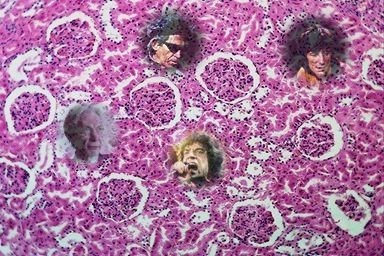
What's the diagnosis?
Answer: Nephrolithiasis
As seen in the H&E stain of the renal tissue
shown above, the presence of multiple Stones in the kidney interstitium
is readily apparent.
This condition, known as nephrolithiasis, or "Kidney
Stones," is a not-uncommon disease affecting hundreds of thousands
of persons in the United States and abroad, although its incidence appears
to be declining as muscial tastes expand into rap, hip-hop, R&B, and
grunge/alternative.
Signs and symptoms vary, but the inability to achieve
the satisfaction of a definitive diagnosis despite trying, trying, trying,
and trying is typical.
The visualization of one or more Stones on a renal
biopsy is pathognomic. Note that the presence of Charlie Watts in the
mesangium, most often seen in teenage women, is a particularly onimous
finding.
The proper treatment of Kidney Stones includes smoking
cessation, Geritol, and ample amounts of Metamucil as needed, with unfortunately
high relapse rates among all age groups.
|


