|
Medical Student Corner
Case Studies: Leg Pain
A 35 year old man presented to Medical Walk-In Clinic
with the chief complaint of leg pain for 3 weeks.
At the time of onset of symptoms, he had been vacationing
in Belize for approximately one month when he noted a slow but progressive
increase in left lower extremity discomfort.
In addition, the patient noted an increasing sensation
of extreme left leg "heaviness," which prevented him from walking
without assistance.
Other than these symptoms, he felt "well,"
and could not recall any specific injury to the leg.
He now presents for further evaluation and management.
On exam, the patient was well-developed and well-nourished,
and appeared in no apparent distress.
Vital signs were unremarkable.
Head & neck, throat, lungs, heart, abdomen, and
neuro exam were all within normal limits.
A close inspection of his lower extremities revealed
the following:
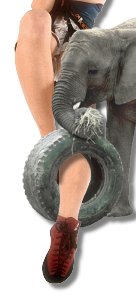
What's the diagnosis?
Answer: Elephantiasis
Although a subtle finding, the presence of an elephant
dangling a tire from its trunk through which the patient's left lower
extremity is extended suggests strongly the diagnosis of elephantiasis.
This condition, caused by the organism Wucheria
bancrofti, not uncommonly affects travelers to regions of the world
in which elephants live in the wild with tires dangling from their trunks.
Because elephantiasis is often mistaken for cellulitis
or lymphedema, for which treatment is markedly dissimilar, it is extremely
important to always inquire about a travel history when investigating
unilateral leg pain and heaviness, as well as to check for the presence
of a large pachyderm in or near the patient's vicinity.
In this patient's case, a three-week course of antibiotics
could have been prevented had the initial clinical investigation noted
the presence of the elephant, its trunk, or the tire dangling from it.
With the proper treatment of bed rest, fluids, and
ibuprofen, the condition resolves on its own within one week, with no
residual damage to either the patient, or to the elephant, trunk, or tire.
|


